




Attention visual field by Metrovision
- Home
- Visual function tests
- Vision psychophysics
- Attention visual field
(This feature is not available for sale in the United States of America)
Introduction
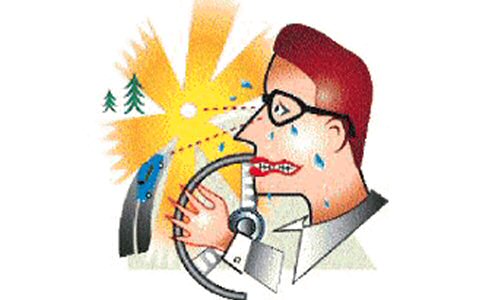
The purpose of this exam is to support clinician in making decision about driving restrictions for patients with visual field alterations and/or brain damage
The ability to drive a vehicle is largely dependent upon the fast and reliable acquisition and analysis of a large number of visual information.
This is evaluated with three different tests of increasing difficulty:
• simple attention,
• divided attention,
• selective attention.
This program has two major clinical applications:
• to evaluate the ability of a subject to compensate a visual field deficit,
• to detect cognitive deficits that may result, for example, from brain infarction or Alzheimer disease
The results of this exam help identifying patients who may benefit from training on a driving simulator
and from a road-test with a specialized driving school.
This program is available on the MonCv3 and MonPackONE systems
Simple attention
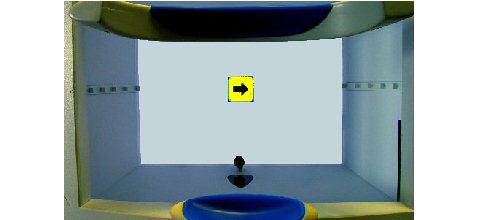
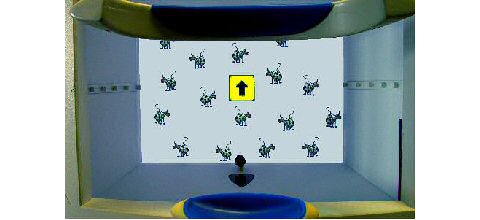
The subject indicates with a level the direction of an arrow appearing on the screen. Performance is evaluated from the percentage of correct responses and from the average response time.
Divided attention
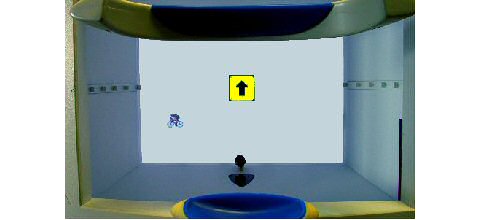
The second phase of the exam involves two simultaneous tasks:
• one central task, identical to the first phase,
• an additional task of peripheral detection of an object appearing at random in the peripheral visual field.
Performance is also evaluated from the percentage of correct responses and from the average response time.
Selective attention
In the third phase, the peripheral task is made more difficult by the addition of visual distractors in the peripheral visual field.
Quantitative analysis
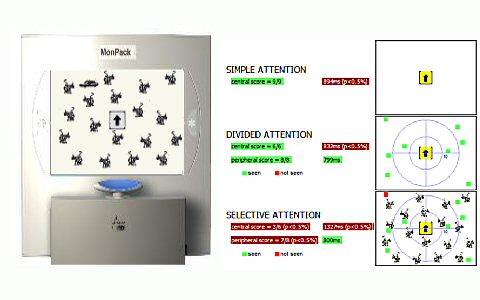
The final report of the three tests includes:
• for simple attention: the number of correct responses
compared to the number of presentations and the average response time.
• for divided attention: the number of correct responses compared to the number of
presentations and the average response time for
central and peripheral tasks. Tests seen in the periphery are indicated in
green and in red if not.
• for selective attention (with distractors): the number of correct responses
compared to the number of presentations and the average response time for central and peripheral tasks.
As in the previous phase, the tests seen in the periphery are indicated in green and in red if not.
References
PDFPrinciple of the useful field of view and normative data.
PDFThe contribution of the useful field of view to allow brain-damaged patients to drive again
PDFVisual ability to drive: application to serious glaucoma.