




Visual aptitudes tests by Metrovision
- Home
- Visual function tests
- Vision psychophysics
- Visual aptitudes
Introduction
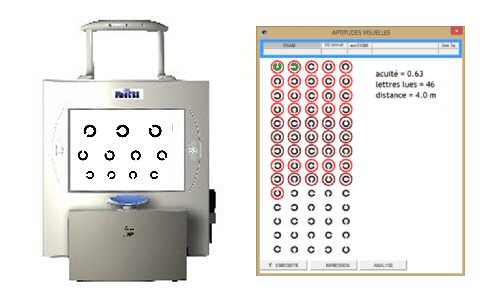
This program includes tests for visual acuity (Landolt and ETDRS),
glare sensitivity and color recognition.
Additional acuity tests are also included for low contrast (10 percent) and low luminance (1 cd/m2)
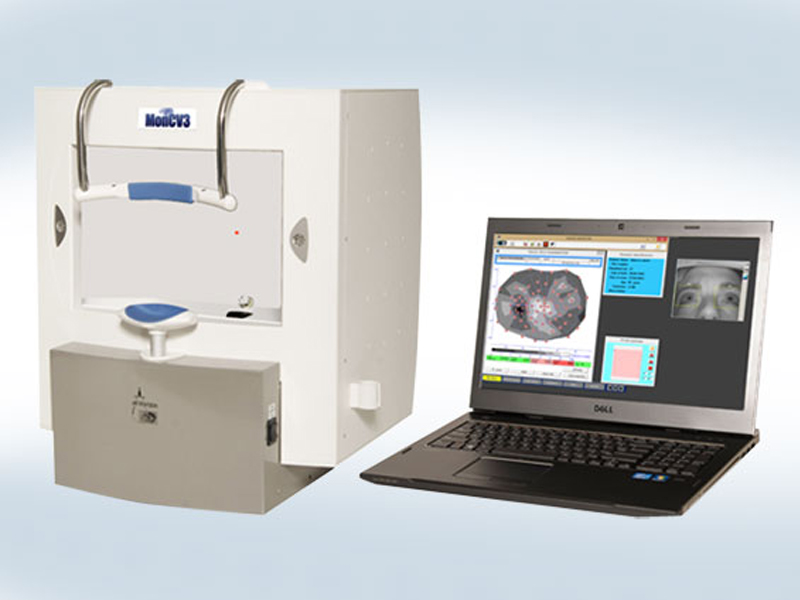
These tests are available on Moncv3 and MonPackONE systems
Landolt visual acuity
This exam meets the ISO 8596-2009 standard for visual acuity measurements
Tests with 8 orientations are used for aptitude assessment.
Tests with 4 orientations are also available for clinical use.
These tests are realized with controlled luminance and contrast. Visual acuity is automatically scored
and the result can be saved in the data base.
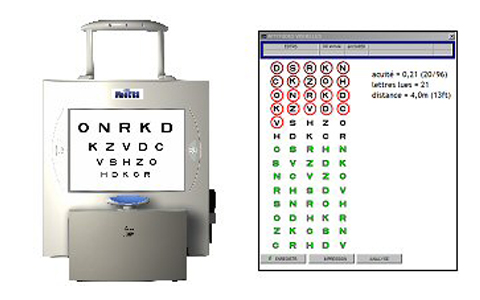
ETDRS visual acuity
These tests include the original ETDRS tests and the the new version of 2000. They can be performed at 13, 8 or 3 ft. They are realized with controlled luminance and contrast. They can be scored with the computer's assistance, recorded and printed.
The ETDRS chart has become a standard for the clinical assessment of visual acuity.
Glare test
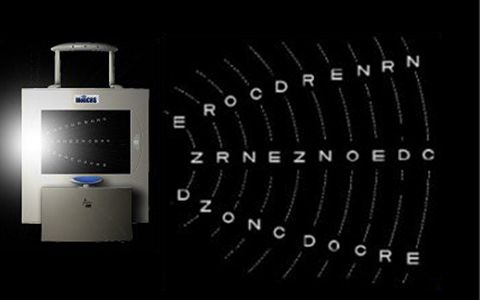
This test measures the size of the glare halo created by a bright light source in conditions similar to night driving.
The MonCv3 and MonPackONE stimulators are equipped with a lateral high luminance light source.
Optotypes of calibrated low luminance are arranged in 3 radial lines of letters with increasing eccentricity from the glare source.
The light from the glare source scattered inside the eye creates a halo of light that reduces the contrast of the optotypes positioned near the light source.
The clinical applications of this test are numerous:
• the early detection of cataract,
• the pre and post operative evaluation in refractive surgery,
• the evaluation of the ability to drive at night.
References
- PDF
Normal sizes of the halo produced by a glare source.
PDFRelationship between halo size and forward light scatter.
PDFCapacity of straylight and disk halo size to diagnose cataract.
PDFComparison of visual function after bilateral implantation of inferior sector-shapednear-addition and diffractive–refractive multifocal IOLs.
Color vision test
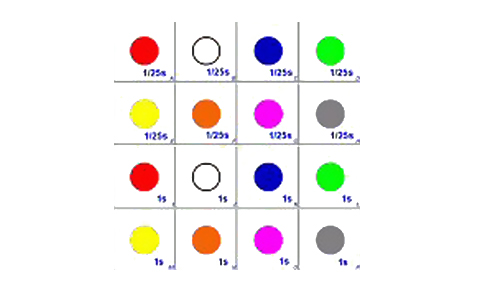
This test evaluates the ability to identify color.
This test is designed as a color lantern test.
Dots with a defined color are presented to the subject.
Presentation time = 1/25 s ou 1 s
Test distance = 2.5 m (8 ft)
Test size = 1 degree visual angle.