




Sweep VEP by Metrovision
- Home
- Visual function tests
- Vision electrophysiology
- Sweep VEP
(This feature is not available for sale in the United States of America)
Introduction
The purpose of this exam is to provide an objective and fast estimation of visual acuity.
This is particularly useful for the examination of non verbal children and of malingering patients. For this purpose, the program generates a pattern stimulus that is alternated at a high temporal frequency rate (in the range of 5 to 15 Hz), producing a steady state visual evoked response. A discrete Fourier transform (DFT) is performed on the recorded signals and provides a real time measurement of the amplitude and phase of the response. This technique can detect a response extremely rapidly. In order to measure visual acuity, the size of the pattern is reduced rapidly. Within 10 seconds, 20 different pattern sizes are presented in succession. This sweep of the spatial resolution domain allows an estimation of visual acuity from the smallest pattern size producing a response.
Methodology
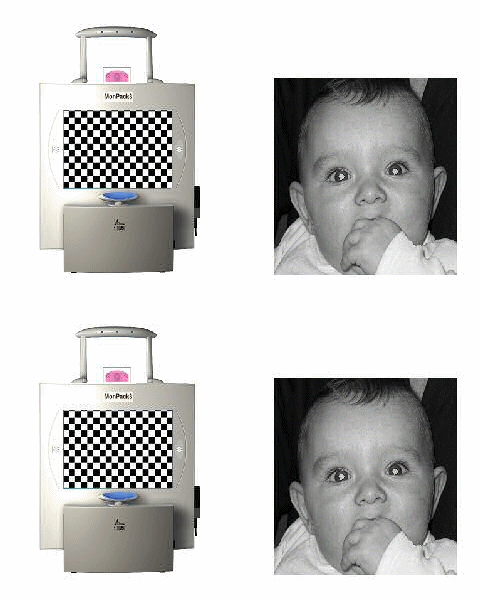
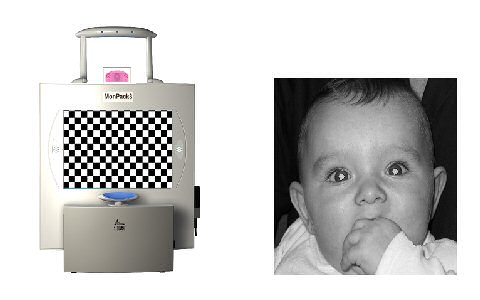
The program starts by generating a cartoon in order to attract the attention of the child. This cartoon is followed by the presentation of a checkerboard with large dimensions. The frequency spectrum of the recorded signal is displayed in real time on the control monitor and allows the operator to visualize the response that is characterized by a peak at the stimulation frequency. The operator can then trigger sweep stimulations that generate a rapid succession of 20 different patterns of decreasing sizes.
This program is available on the MonPackONE systems. The external camera (option) is highly recommended to monitor the fixation of the subject.
Determination of visual acuity
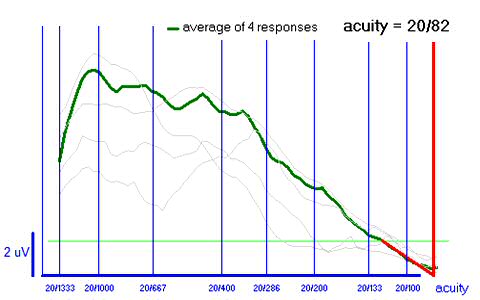
The program calculates the vector average of the different sweep responses recorded during the exam. Vector averaging is an efficient way to reduce the noise level and to evaluate the reproducibility of responses. From this vector average, the program automatically determines visual acuity as the smallest size of pattern that produces a response (20/82 in the present example).
References
PDF →Comparison of sweep visual evoked potential of visual acuity and Snellen visual acuity in healthy and amblyopic children
PDF →Evaluation of Agreement Between Sweep Visual Evoked Potential Testing and Subjective Visual Acuity
PDF →Pattern and sweep visual evoked potential in the objective determination of visual acuity
PDF →Clinical Features of a Pediatric Case with Cone Dystrophy
PDF →Evaluation of magnitude and phase of sweep visual evoked potentials
PDF →Evaluation of visual acuity with sweep VEP method
PDF →Estimation objective et rapide de l’acuité visuelle grâce au PEV sweep